On this page
Key facts
- Length, 1999-on trucks
- 3,395 mm (133.7 in)
- Width, 1999-on trucks
- 1,475 mm (58.1 in)
- Bed, 1999-on Carry and Acty
- 1,940 x 1,410 mm (76.4 x 55.5 in)
- Rated load
- 350 kg (about 770 lb)
- Curb weight
- About 650 to 860 kg (1,430 to 1,900 lb)
- Engines
- 656 to 659 cc, rated 38 to 58 PS
- Factory tire
- 145R12 6PR LT
These are the numbers owners ask about most. Figures come from maker spec sheets (Suzuki's 1991 and 1999 Carry sheets, Honda's 1994 Acty press release and its archived 2003-2007 Acty data) and from Japanese catalog data. Anything marked approx. is a typical figure rather than a published one. Grades and years vary, so check your truck's paperwork or a factory service manual; Oiwa Garage carries Kei Truck service manuals for the common chassis.
How big is a Kei Truck?
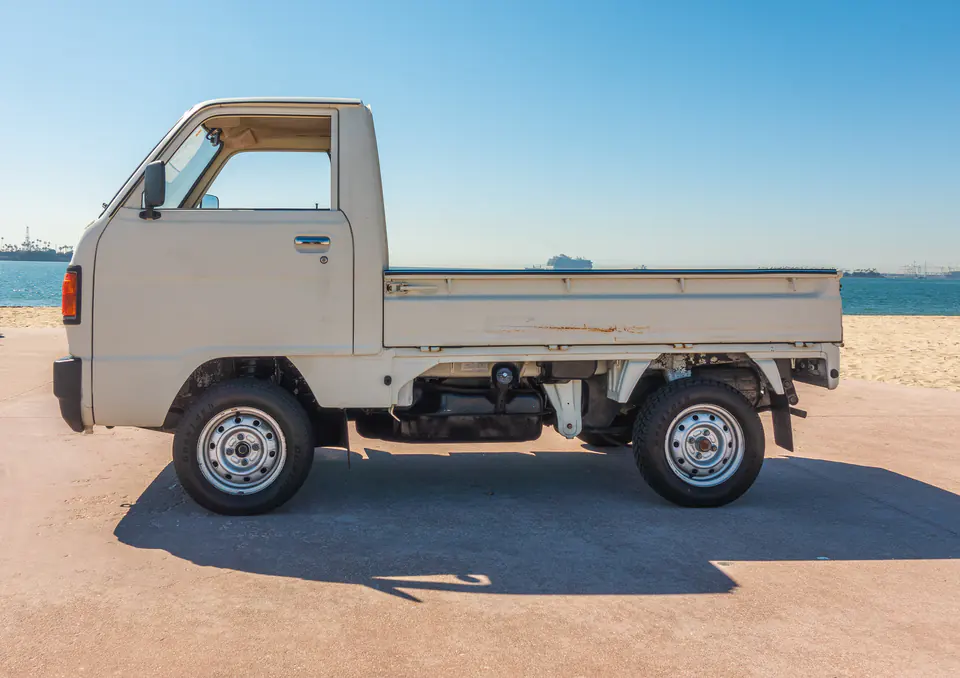
A Kei Truck built after the October 1998 rule change measures about 3,395 mm long and 1,475 mm wide (133.7 x 58.1 in), while most 1990s trucks measure about 3,295 x 1,395 mm (129.7 x 54.9 in). The size follows Japan's Kei limits, which every maker builds right up to:
| Kei rules in force | Engine limit | Max length | Max width | Max height | Typical truck, length x width |
|---|---|---|---|---|---|
| 1955-1975 | 360 cc | 3,000 mm (118.1 in) | 1,300 mm (51.2 in) | 2,000 mm (78.7 in) | Varies |
| 1976-1989 | 550 cc | 3,200 mm (126.0 in) | 1,400 mm (55.1 in) | 2,000 mm (78.7 in) | Varies |
| 1990 to September 1998 | 660 cc | 3,300 mm (129.9 in) | 1,400 mm (55.1 in) | 2,000 mm (78.7 in) | 3,295 x 1,395 mm (Acty: 3,255 mm long) |
| October 1998 to today | 660 cc | 3,400 mm (133.9 in) | 1,480 mm (58.3 in) | 2,000 mm (78.7 in) | 3,395 x 1,475 mm |
Height varies the most. Standard trucks stand about 1,710 to 1,850 mm (67 to 73 in) depending on model and drive, and racks, campers and special bodies add more.
Length can matter legally. North Carolina, for one, caps its mini-truck definition at 130 inches (N.C. Gen. Stat. 20-4.01), and similar wording appears in some other state laws and bills. A 1990s truck at 129.7 inches fits under that number, while a 1999-on truck at 133.7 inches does not. Check the Kei Truck laws by state to see how your state words it.
What are the dimensions and weights of each Kei Truck?
The table covers the ten truck generations most often imported, five from the 1990s and five from 1999-2001. Output is the Japanese net rating in PS (metric horsepower); 1 PS is about 0.986 hp. Pound conversions are rounded.
| Truck | Engine | Built | Length x width x height (mm) | Curb weight | Output | Fuel tank |
|---|---|---|---|---|---|---|
| Suzuki Carry DC51T/DD51T | F6A, 657 cc, 3-cyl | 1991-1999 | 3,295 x 1,395 x 1,715-1,805 | 650-710 kg (about 1,430-1,570 lb) | 42 PS (41 hp) | 36 L (9.5 gal) |
| Suzuki Carry DA52T/DB52T | F6A, 657 cc, 3-cyl | 1999-2001 | 3,395 x 1,475 x 1,790 | 670-740 kg (about 1,480-1,630 lb) | 42-50 PS (41-49 hp); turbo 56 PS (55 hp) | 40 L (10.6 gal) |
| Daihatsu Hijet S100P/S110P | EF, 659 cc, 3-cyl | 1994-1999 | approx. 3,295 x 1,395 | approx. 650-750 kg | approx. 42 PS (41 hp) | approx. 38 L |
| Daihatsu Hijet S200P/S210P | EF-SE, 659 cc, 3-cyl | 1999-2001 | 3,395 x 1,475 x 1,780 | 700-750 kg (about 1,540-1,650 lb) | 43 PS (42 hp) at launch | 38 L (10.0 gal) |
| Honda Acty HA3/HA4 | E07A, 656 cc, 3-cyl | 1990-1999 | 3,255 x 1,395 x 1,710-1,715 | 670-710 kg (about 1,480-1,570 lb) | 38 PS (37 hp) | Not confirmed |
| Honda Acty HA6/HA7 | E07Z, 656 cc, 3-cyl | 1999-2001 | 3,395 x 1,475 x 1,715-1,745 | 780-840 kg (about 1,720-1,850 lb) | 46 PS (45 hp) | 37 L (9.8 gal) |
| Subaru Sambar KS3/KS4 | EN07, 658 cc, 4-cyl | 1990-1999 | 3,295 x 1,395 x 1,805-1,845 | approx. 700-760 kg | 40-46 PS (39-45 hp); supercharged 55 PS (54 hp) | 40 L (10.6 gal) |
| Subaru Sambar TT1/TT2 | EN07, 658 cc, 4-cyl | 1999-2001 | 3,395 x 1,475 x 1,815-1,830 | 720-810 kg (about 1,590-1,790 lb) | 48 PS (47 hp); supercharged 58 PS (57 hp) | 40 L (10.6 gal) |
| Mitsubishi Minicab U41T/U42T | 3G83, 657 cc, 3-cyl | 1991-1999 | 3,295 x 1,395 x approx. 1,815 | approx. 680-760 kg | approx. 42 PS (41 hp) | 40 L (10.6 gal) |
| Mitsubishi Minicab U61T/U62T | 3G83, 657 cc, 3-cyl | 1999-2001 | 3,395 x 1,475 x 1,785-1,790 | 770-860 kg (about 1,700-1,900 lb) | approx. 48 PS (47 hp) | 40 L (10.6 gal) |
A few notes on reading it:
- Weights cover common grades. Dump bodies weigh more: Suzuki's 1991 sheet lists its dump trucks at 740 to 790 kg, and a 1999 Hijet low-deck dump is listed at 840 kg.
- Output changed within generations. Carbureted engines generally rate lower than the fuel-injected versions that followed, and the Hijet's EF-SE rose from 43 to 45 PS during the S200P run.
- Every row is importable as of October 2026 if the specific truck was built in October 2001 or earlier.
- Fuel economy: on Japan's 10-15 test cycle, Suzuki rated the 1999 Carry between 14.4 and 16.6 km/L (about 34 to 39 mpg), and Honda rated the 2003-2007 Acty between 16.2 and 17.6 km/L (about 38 to 41 mpg). Real driving, especially loaded or at highway speed, returns less.
What are the bed dimensions of a Kei Truck?
On 1999-and-later trucks, Suzuki and Honda both list an inside bed that measures 1,410 mm across and 1,940 mm front to back, with 290 mm side walls; 1990s beds share that length but are narrower.
| Truck (data year) | Bed length | Bed width | Side height | Load floor height |
|---|---|---|---|---|
| Suzuki Carry DC51T/DD51T (1991) | 1,940 mm (76.4 in) | 1,330 mm (52.4 in) | 290 mm (11.4 in) | 640 mm (25.2 in) |
| Honda Acty HA3/HA4 (1994) | 1,940 mm (76.4 in) | 1,330 mm (52.4 in) | 290 mm (11.4 in) | Not listed |
| Suzuki Carry DA52T/DB52T (1999) | 1,940 mm (76.4 in) | 1,410 mm (55.5 in) | 290 mm (11.4 in) | 660 mm (26.0 in) |
| Honda Acty HA6/HA7 (2003-2007) | 1,940 mm (76.4 in) | 1,410 mm (55.5 in) | 290 mm (11.4 in) | 660 mm (26.0 in) |
Hijet, Sambar and Minicab beds of the same eras are close to these figures; measure yours before building racks. Practical points:
- No wheel wells in the floor. The bed sits above the rear wheels, so the floor is flat edge to edge.
- A 4 x 8 ft sheet fits between the sides on trucks of either era, but it overhangs the end of the bed floor by about 20 inches.
- Dump and Jumbo-cab beds are shorter. Honda's 1994 Acty dump beds ran 1,660 to 1,840 mm long, depending on type.
What does the 350 kg payload rating mean?
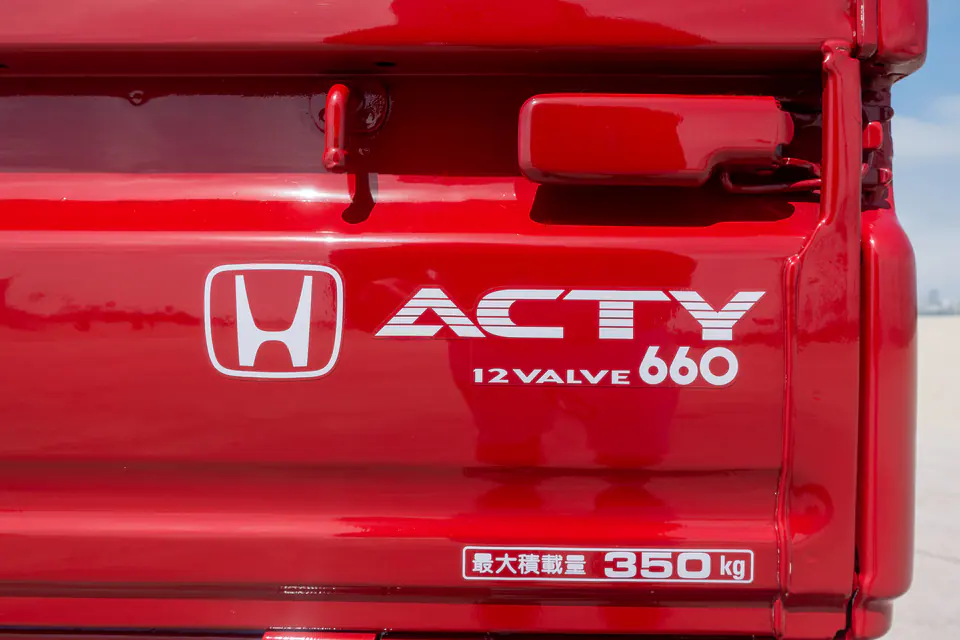
Every Kei Truck is rated for a maximum load of 350 kg (771.6 lb), and that figure appears on maker spec sheets and Japanese registration papers. It covers cargo only, since the two seats are counted separately.
Japanese paperwork also lists a gross vehicle weight: curb weight plus the 350 kg load plus 55 kg per seat, roughly 1,110 to 1,320 kg (about 2,450 to 2,910 lb) for the trucks above. If a US form asks for a gross weight, start with the export certificate figure and ask your DMV which number it wants.
The rating reflects what the springs, the load-rated 145R12 tires and the brakes (front discs and rear drums on the Suzuki sheets) were built to handle. Racks, toolboxes and campers count against it, and a full 100-gallon water tank alone weighs about 834 lb. Sagging rear springs on a used truck usually mean years of heavy loads, and Oiwa Garage carries Kei Truck suspension parts to refresh them. Planning a slide-in camper? Our Kei Truck camper guide covers weight budgets.
What tires does a Kei Truck use?
The factory tire on these trucks is the 12-inch 145R12 6PR LT, a load-rated light-truck radial, and some early 1990s work grades left the factory on 5.00-12 bias-ply tires.
- DOT markings. Tires fitted in Japan may lack the DOT code that some state inspections look for. Fresh DOT-marked tires are an easy first upgrade.
- Going bigger. Many owners move to 13- or 14-inch wheels for more tire choices and a little clearance. Larger tires make every gear taller and the speedometer read below your true speed.
- Wheels and fitment. Bolt patterns and offsets vary by model and year, so confirm yours before ordering wheels. Kei Truck hub adapters let you run wheels with a different pattern, and a Kei Truck lift kit makes room for taller tires. Our Kei Truck mods guide covers what works.
How fast does a Kei Truck go?
Expect a comfortable cruise of roughly 45 to 55 mph and a top speed around 60 to 70 mph on level ground. These are approximate, owner-reported figures that vary with gearing, load and engine condition.
Gearing explains why. Suzuki's 1999 sheet gives the 4WD 5-speed Carry a 0.855 fifth gear and a 6.833 final drive. With the factory 145R12 tire, that means a little over 5,000 rpm at 55 mph (our calculation, approximate), close to the 5,500 to 6,000 rpm where the engine makes peak power.
Suzuki's 1999 sheet lists the 3-speed automatic only with the turbo engine. By our math, it turns about 7% more rpm than the matching turbo 5-speed (0.855 fifth, 6.428 final drive) in 2WD form and about 12% more in 4WD form, and its three ratios leave wide gaps on hills. Turbo and supercharged trucks hold speed on grades best.
Some states limit Kei Trucks to roads with lower posted speeds, so the law may cap you before the engine does. For the bigger picture, see what a Kei Truck is and our Kei Truck model comparison.
Frequently asked questions
How long is a Kei Truck?
A Kei Truck built from 1999 on is about 3,395 mm (133.7 in) long, just under Japan's 3.40 m limit. Most 1990s trucks are about 3,295 mm (129.7 in) long, and the 1990s Honda Acty is about 3,255 mm (128.1 in). Dump bodies, bumpers and racks can add a little to those figures.
What are a Kei Truck's bed dimensions?
On 1999-and-later trucks, Suzuki and Honda list an inside bed that measures 1,410 mm across and 1,940 mm front to back, with 290 mm side walls, or roughly 55 by 76 inches. 1990s beds are the same length but about 1,330 mm (52.4 in) wide. The sides fold down on three edges, and the floor sits about 25 to 26 inches off the ground.
What does a Kei Truck weigh empty?
Most standard-bed Kei Trucks weigh between about 650 and 860 kg empty, or roughly 1,430 to 1,900 lb, depending on model, drive and equipment. 1999-on trucks tend to weigh more than 1990s trucks, and 4WD, air conditioning, automatics and dump bodies all add weight. The export certificate lists your truck's exact figure.
What is the payload of a Kei Truck?
Every Kei Truck is rated for a maximum load of 350 kg, which is about 770 lb. That figure covers cargo only, not the two occupants. Anything you add to the truck, such as racks, toolboxes, sprayer tanks or a camper, counts against it, and a full 100-gallon water tank alone would exceed it.
What size tires does a Kei Truck use?
Factory tires are 12-inch 145R12 6PR LT light-truck radials, and some early 1990s work grades came on 5.00-12 bias-ply tires. Many US owners switch to 13- or 14-inch DOT-marked tires for wider choice and a little more clearance. Larger tires change gearing and speedometer readings, so size up modestly.
How big is a Kei Truck fuel tank?
Maker and catalog data put most Kei Truck tanks between 36 and 40 liters, about 9.5 to 10.6 gallons. Suzuki listed 36 L for the 1991 Carry and 40 L for the 1999 Carry, Honda lists 37 L for the HA6/HA7 Acty, and catalog data shows 38 L for the 1999 Hijet and 40 L for the Sambar and Minicab.
Will a Kei Truck fit in my garage?
Almost certainly, if the truck is stock. Standard Kei Trucks stand about 1,710 to 1,850 mm (67 to 73 in) tall, and Japan caps the whole class at 2.00 m (78.7 in), which is under a typical 7-foot residential garage door. Racks, campers, lift kits and high-roof bodies change the answer, so measure first.